 Rebound File Manager
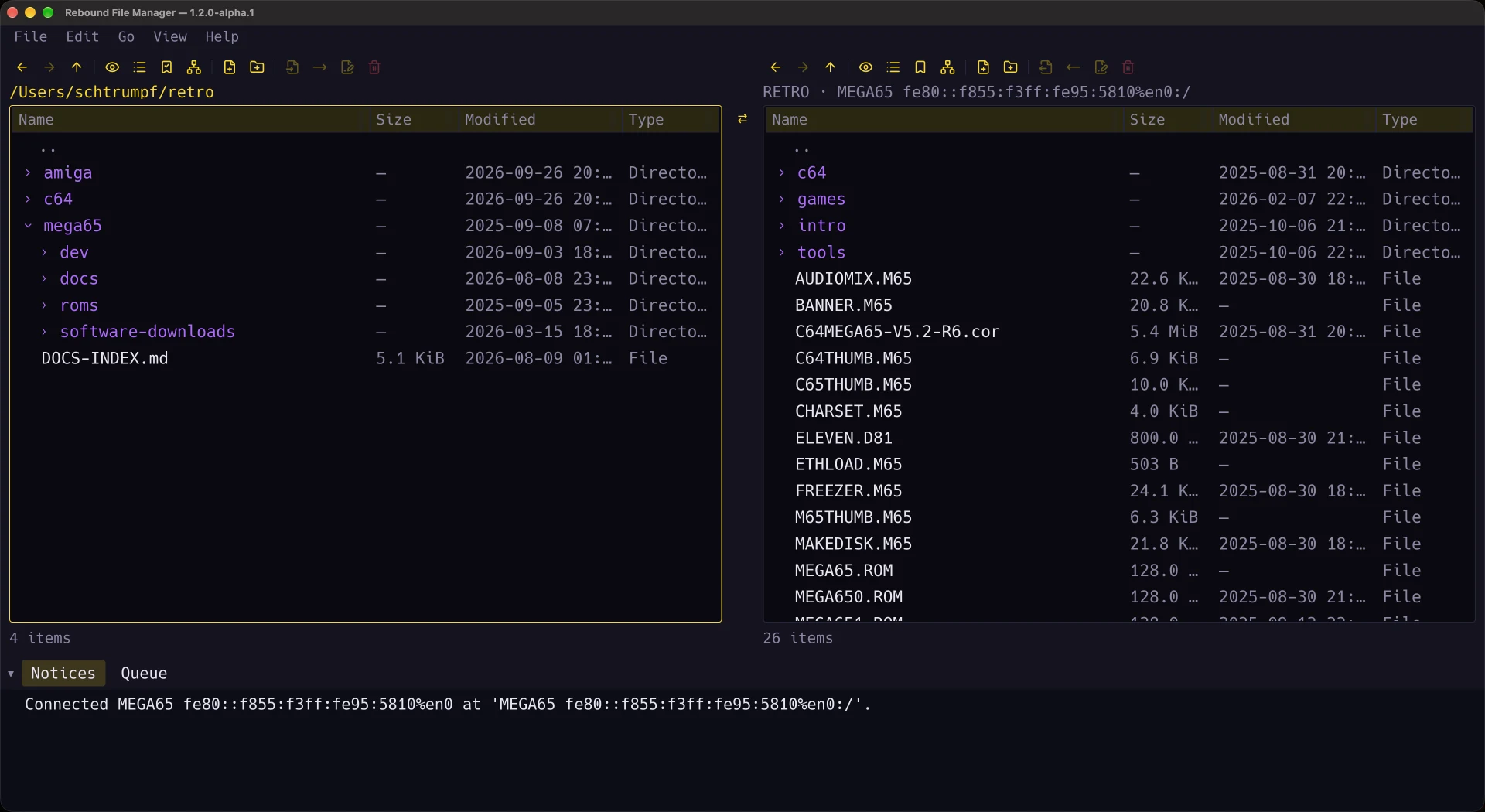
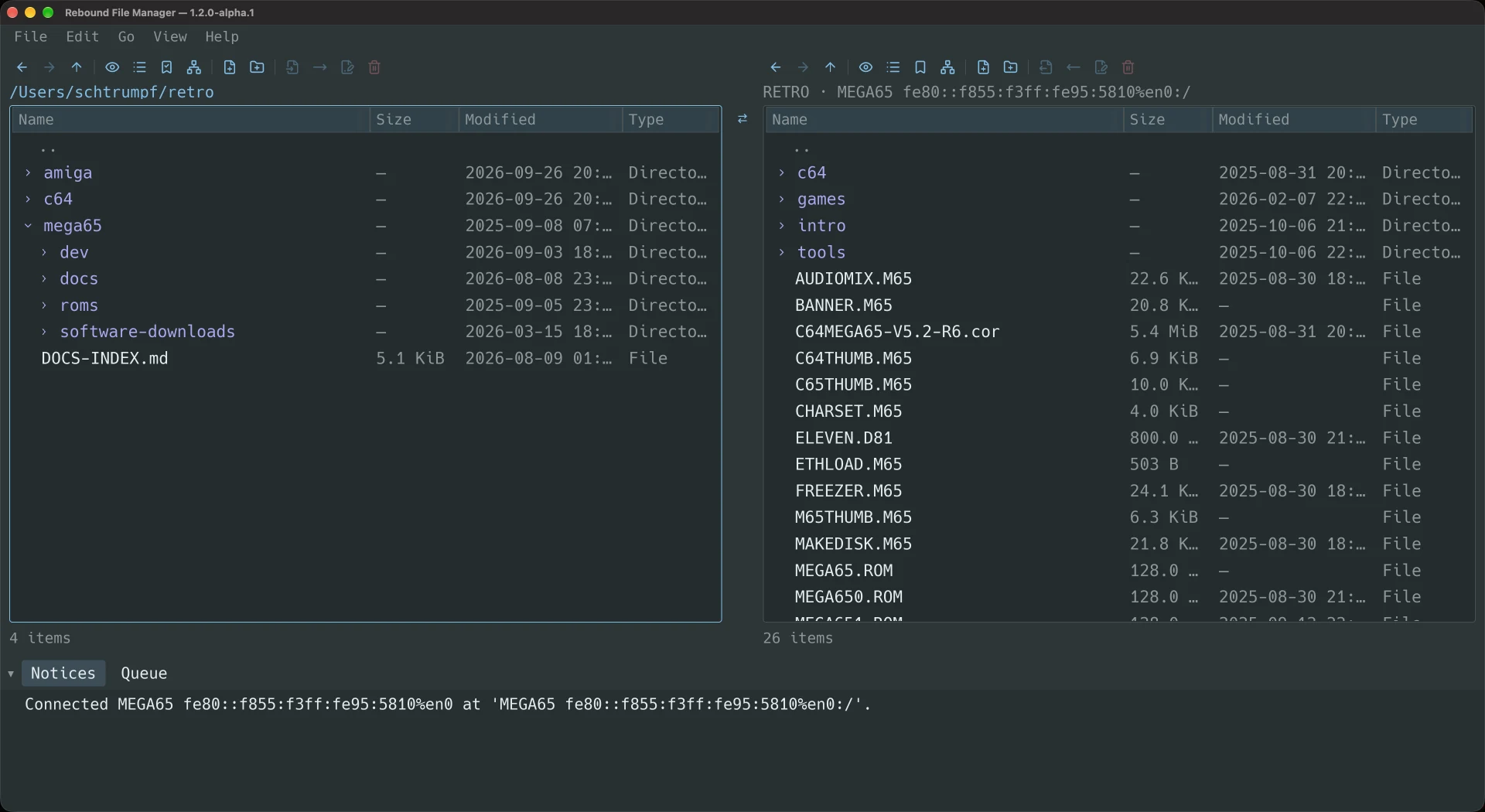
Two panes, one on the left, one on the right, and a copy goes from whichever has the focus to the other one. That part is fifty years old and still the fastest way to move files. What is new is what a pane is allowed to be: a folder on this Mac, a machine mounted over SSHFS, or a real retro machine — the C64 Ultimate, the MEGA65 SD card or Apollo. Capabilities differ by provider, and the app exposes those differences rather than pretending every location is a local disk.
What it does
- Both panes browse independently, with history, a tree that opens in place rather than navigating away, and a cursor that survives a reload as long as the file does.
- Refusals instead of guesses. Every location says what it can do. If the far side cannot rename, you get told it cannot rename; you do not get a filesystem-shaped lie.
- Transfers between providers, with queued, running, conflict, cancelled, failed and refused as distinct visible states.
- Long names elide from the font's own metrics — in the middle for names, at the tail for metadata — and a truncated cell shows the whole value on hover while a cell that fits shows nothing.
- Keyboard first, including
Tabwalking a dialog's fields.
Where it actually stands
The current development version is 1.2.0-alpha.1, installed on 2026-10-02.
It also lives inside Studio's shared strip, with project-bound panes, protected writes and
transfer-aware closing. The same-version build installed on 2026-10-03 adds empty D64, D81
and ADF creation with a separate disk name.
Apollo and MEGA65 are working locations now, not empty slots. Apollo's measured server does not support rename; the MEGA65 interface has no directory removal or free-space report. The remaining provider matrix and daily-use feedback are still release gates.
Screenshots
What’s next
- Daily use of the installed candidate and feedback on the Studio integration.
- The remaining cross-provider matrix and Linux package before beta.